

Shajareh Tayyebeh Girls’ Elementary School, Minab
The Shajareh Tayyebeh (meaning ‘Sacred Tree’ in Persian) girls’ elementary school stood in the Shahrak-e Al-Mahdi neighbourhood of Minab, a city in Hormozgan province in southern Iran. Partially destroyed in a US missile attack on the first day of the 2026 Iran war, the Shajareh Tayyebeh (meaning ‘Sacred Tree’ in Persian) girls’ elementary school stood in the Shahrak-e Al-Mahdi neighbourhood of Minab, a city in Hormozgan province in southern Iran. This blog is about lost buildings. The greater loss here was not the building, though, but rather the loss of life.
What Was It
The Shajareh Tayyebeh school was a two-storey primary school serving the children of the Shahrak-e Al-Mahdi neighbourhood. Though formally registered as a girls’ elementary school, it accommodated both boys and girls, taught on separate floors. The school had a vivid online presence, a brightly painted exterior, outdoor football and volleyball pitches, and muralled walls adorned with paintings of crayons, children, and an apple, unmistakable markers of a civilian educational facility.
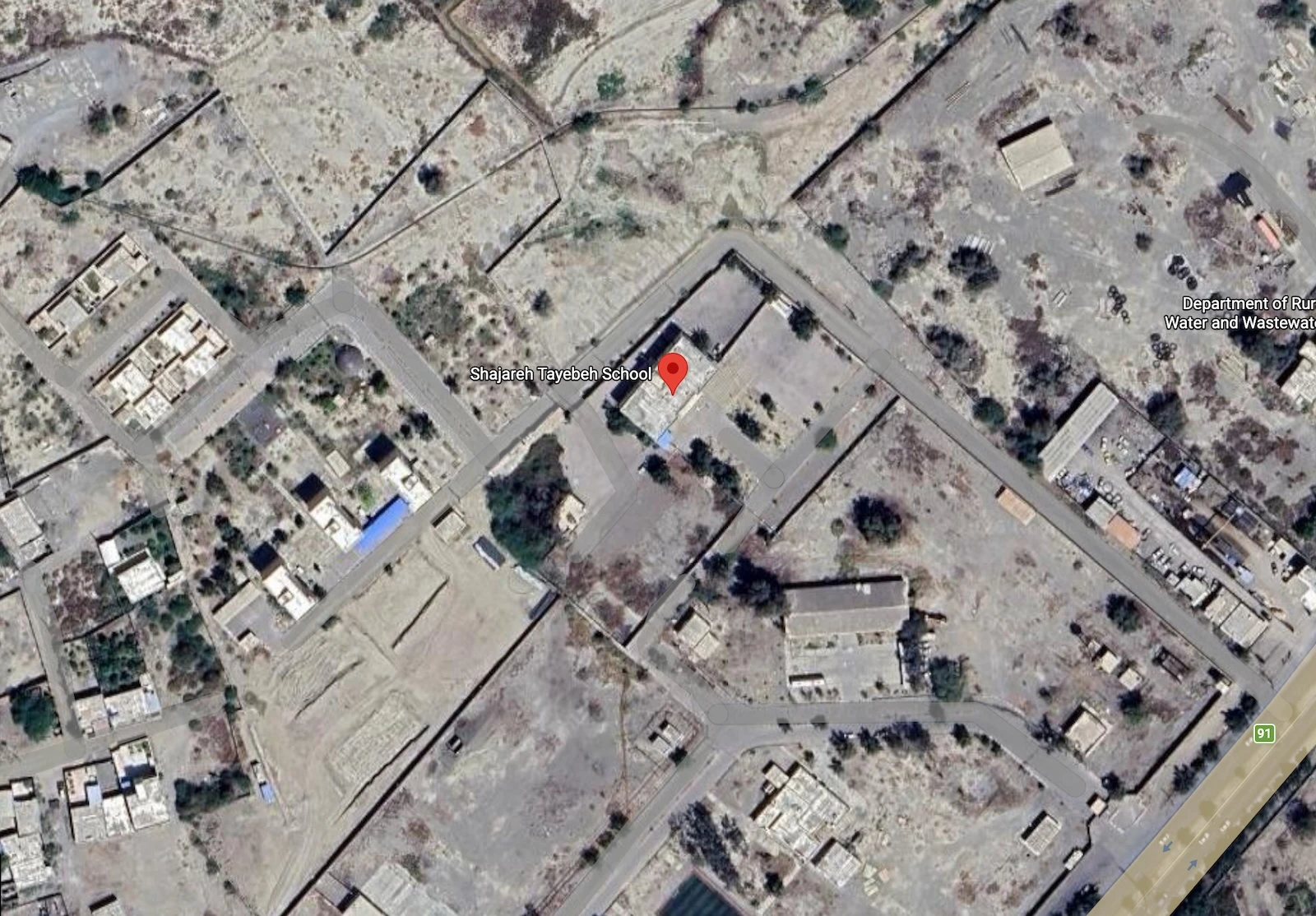
The school sat adjacent to what had formerly been the Sayyid al-Shuhada military complex, which once housed the headquarters of the Asif Brigade of the Islamic Revolutionary Guard Corps Navy (IRGCN). However, satellite imagery confirmed the school had been walled off from the compound since at least September 2016, with three independent entrances and no military security checkpoints. According to Minab’s mayor, the compound had been closed for approximately 15 years by the time of the attack, with all military personnel having vacated the premises. The school was the only operational facility remaining on the former base.
Where Was It
The school was located in the Shahrak-e Al-Mahdi neighbourhood of Minab, a city in Hormozgan province in Iran’s far south, close to the Strait of Hormuz. Minab sits approximately 80 kilometres east of Bandar Abbas, the provincial capital and a major naval hub, in the heart of a residential neighbourhood adjacent to what had once been an IRGCN military compound but had long since been decommissioned for active military use.
Key Dates
- Pre-2013. The school building is part of the Sayyid al-Shuhada IRGCN military compound.
- By September 2016. The school is walled off from the compound, establishing three independent entrances with no military checkpoints.
- 2017. Satellite imagery confirms a civilian outdoor play area within the school perimeter.
- 28 February 2026, approx. 10:00 a.m. IRST. The 2026 Iran war begins. Schools across Iran begin closing. Staff at Shajareh Tayyebeh stay inside to help escort children out.
- 28 February 2026, 10:23 to 10:45 a.m. IRST. The school is struck by at least three separate missiles, a triple-tap strike. The roof collapses. Dozens are killed instantly.
- 28 February 2026, afternoon. Rescue workers, Red Crescent volunteers, and civilians begin digging through rubble with their hands. Bodies are recovered in bags; school books are found stained with blood.
- 1 March 2026. Search operations for survivors conclude. Death toll surpasses 150.
- 3 March 2026. A mass funeral is held in Minab’s central square, attended by thousands of mourners. Excavators prepare over 100 graves at Minab Hermud cemetery.
- 4 March 2026. US Secretary of State Marco Rubio says the Pentagon is investigating whether the US fired the strike. Defence Secretary Pete Hegseth echoes the denial, saying the US “would never target civilian targets.”
- 5 March 2026. Reuters reports two US military personnel involved in an internal investigation believe the strike was likely perpetrated by the US.
- 11 March 2026. The New York Times reports preliminary investigation findings conclude the US was responsible. The school was likely targeted due to outdated coordinates provided by the Defense Intelligence Agency.
- 13 March 2026. US Secretary of Defense Pete Hegseth promises a “thorough probe,” described by the Washington Post as a tacit acknowledgement of US responsibility.
- 17 March 2026. A UN investigation is initiated.
Key Players
The students and staff of Shajareh Tayyebeh were the primary victims. At least 175 people were killed, over 100 of them schoolchildren, predominantly girls aged 7 to 12. Teachers and the school’s principal were also killed, along with parents who had rushed to the building to collect their children after the first strike.
The United States Armed Forces were determined by multiple independent investigations, satellite analyses, munition expert assessments, and preliminary Pentagon findings to be responsible for the strike. Tomahawk cruise missiles, a weapon exclusively used by the US in the conflict, were identified at the scene by Bellingcat, BBC Verify, Amnesty International, and numerous munition specialists. A satellite data link antenna manufactured by Ball Aerospace and Technologies, a US contractor, was recovered from the wreckage.
The Defense Intelligence Agency (DIA) was identified in preliminary Pentagon findings as having provided outdated targeting coordinates that likely caused the school to be mistakenly classified as a military site.
Maven Smart System (Palantir), an AI-based targeting tool used by the US military, was reported to have played a role in generating the strike package. The Washington Post reported that intelligence had tagged the school as either a factory or arms depot before it was approved as a target.
Human Rights Watch (HRW) and Amnesty International published independent investigations condemning the strike as a violation of international humanitarian law, calling for accountability and prosecution of those responsible.
UNESCO was the first international body to condemn the strike on the day of the attack, calling it “a grave violation of humanitarian law.”
UN Secretary-General Antonio Guterres and UN High Commissioner Volker Turk both condemned the attack and called for a prompt, impartial, and thorough investigation.
Malala Yousafzai, UN Messenger of Peace and Nobel Peace laureate, said the news left her “heartbroken and appalled.”
The Story Behind It
On the morning of 28 February 2026, Iran and the United States entered open war. Airstrikes began at approximately 10:00 a.m. local time, a Saturday, which is a working and school day in Iran. Schools began announcing closures. Staff at Shajareh Tayyebeh decided to close even before the national announcement at 10:15 a.m., but many parents could not reach the school in time.
Between 10:23 and 10:45 a.m., the school was struck. Witnesses described a first missile impact that brought sections of the building down. The school principal moved surviving students to a prayer room and called parents. A second strike hit that room. Then a third. The roof of the two-storey building collapsed, burying children, teachers, and parents beneath concrete and steel.
Recovery workers arrived to find the brightly painted football pitches filled with smoke. They dug with their hands. One man emerged from the rubble waving dust-covered textbooks stained with blood, shouting: “These are the schoolbooks of the children who are under these ruins. These are civilians, who are not in the military. This was a school and they came to study.”
At least 175 people were killed. The morgues of Minab overflowed; bodies were stored in refrigerated trucks. The attack flooded a city in grief.
The US government initially denied responsibility. President Trump claimed the strike was “done by Iran.” But independent investigations by Bellingcat, BBC Verify, NPR, the CBC, HRW, Amnesty International, and the New York Times all concluded the same thing: an American Tomahawk missile struck a school full of children. Preliminary Pentagon findings, reported in March 2026, confirmed that the school had been placed on a US target list, likely misidentified as a military site using intelligence that was over a decade out of date.
Multiple US senators and over 120 members of Congress demanded answers. A UN investigation was launched. The question of who, or what, bears ultimate responsibility for feeding a school full of children into a precision airstrike targeting algorithm remains, at the time of writing, unresolved.
“This harrowing attack on a school, with classrooms full of children, is a sickening illustration of the catastrophic and entirely predictable price civilians are paying during this armed conflict.” Erika Guevara Rosas, Amnesty International