

Pennsylvania Station, New York
The original Pennsylvania Station was an architectural and cultural icon. Its destruction in 1963 became a turning point in how America thought about its architectural heritage.
What Was It?
Pennsylvania Station was a monumental Beaux-Arts railway station that occupied two full city blocks in Midtown Manhattan. Modelled on the Roman Baths of Caracalla, it featured a grand waiting room with 150-foot vaulted ceilings, pink granite walls, and a vast iron and glass concourse, flooded with natural light.
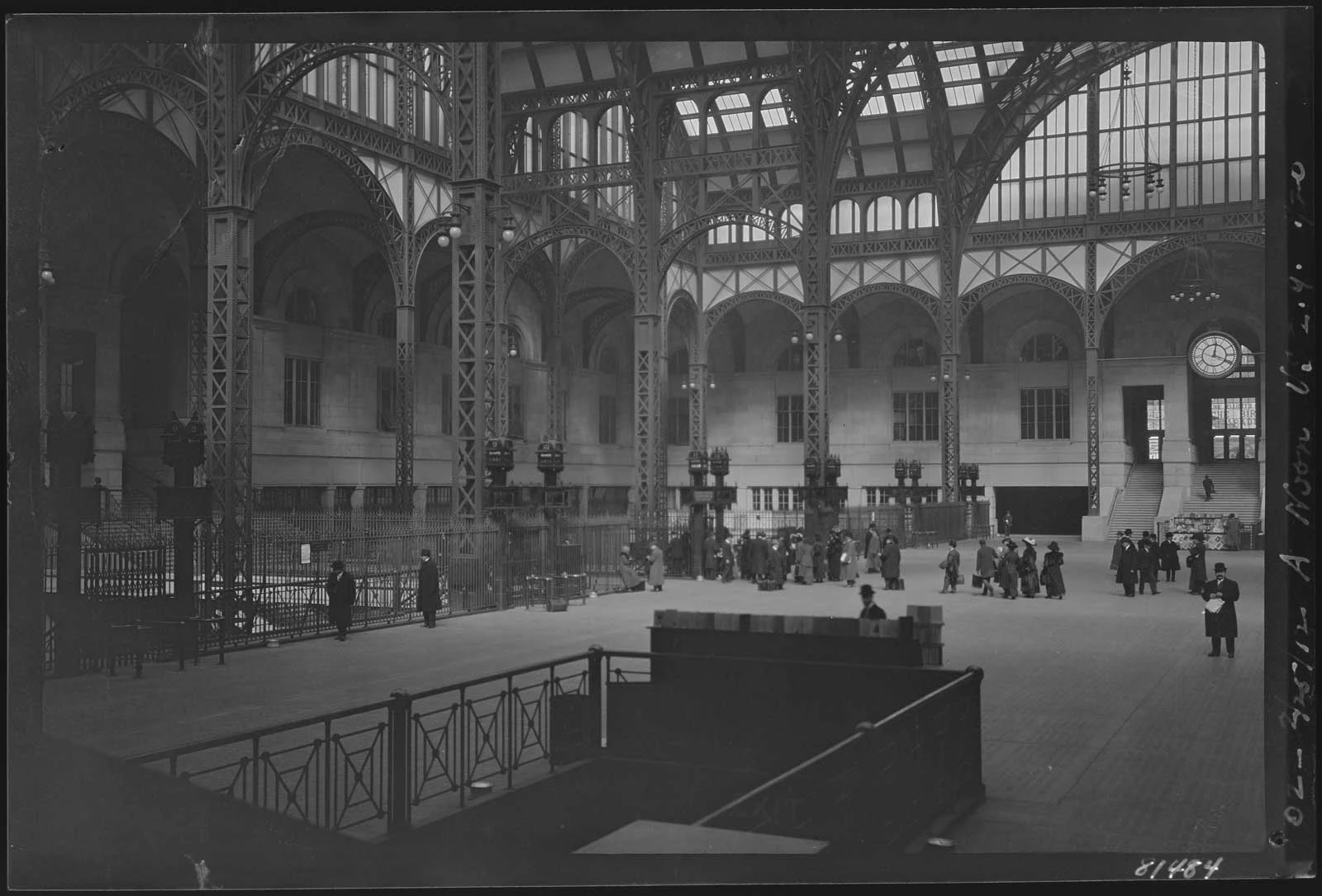
It was not just a transit hub. It was a civic room, a grand public space where passengers’ arrival in New York was a momentous occasion.

__
Design Details
Lorem ipsum…
Where Was It?
Penn Station occupied the block bounded by Seventh and Eighth Avenues, and 31st and 33rd Streets in Midtown Manhattan, New York City. The site covered approximately 8 acres above ground, with platforms running underground. This layout still exists in the version that replaced it.
Key Dates
- 1901. Pennsylvania Railroad commissions architectural firm McKim, Mead and White.
- 1904. Construction begins.
- 1910. Station opens to the public on November 27.
- 1958. Pennsylvania Railroad announces plans to sell the air rights.
- 1961. Demolition plans made public, triggering immediate outcry.
- 1963. Demolition begins in October.
- 1968. The new, subterranean Penn Station opens beneath Madison Square Garden.
Key Players
McKim, Mead and White designed the station, with Charles Follen McKim leading the project. It was considered the pinnacle of the firm’s output and one of the greatest public buildings ever constructed in the United States.
The Pennsylvania Railroad owned and ultimately condemned the building, citing financial losses and the untapped value of the air rights above the site.
Madison Square Garden Corporation purchased the air rights, resulting in the construction of the current arena directly above the station.
Ada Louise Huxtable of the New York Times was among the most prominent voices opposing demolition, writing angrily about the impending loss.
Action Group for Better Architecture in New York (AGBANY), a group of architects, planners, and citizens formed in the early 1960s to oppose the demolition of Penn Station.
The Story Behind It
The demolition of Penn Station was driven by economics. The Pennsylvania Railroad was haemorrhaging money as car ownership and air travel eroded passenger numbers. The air rights above the station were valued at tens of millions of dollars, enough to keep the railroad solvent.
There were no legal protections for historic buildings in New York City at the time. No landmark law existed to protect it.
The public outcry was fierce but ultimately futile. Protesters outside the station carried signs reading “Don’t Amputate, Renovate” and “Save Our City”. Architecture critics called it an act of civic vandalism.
The destruction of Penn Station directly led to the creation of the New York City Landmarks Preservation Commission in 1965, arguably the most consequential act of preservation legislation in American history. The Grand Central Terminal, threatened with the same fate shortly after, was saved as a direct result.
As the architecture critic Ada Louise Huxtable wrote at the time:
“We will probably be judged not by the monuments we build but by those we have destroyed.”