

Lighthouse of Alexandria (Pharos), Alexandria
For over a thousand years, the Pharos of Alexandria was one of the tallest structures in the world. Built on the island of Pharos in the harbour of Alexandria, it guided ships into one of the ancient world’s greatest ports. Earthquakes damaged it, builders stripped it for stone, and by the fourteenth century it had fallen out of use. Its name lives on in the word for lighthouse in many languages.
What Was It
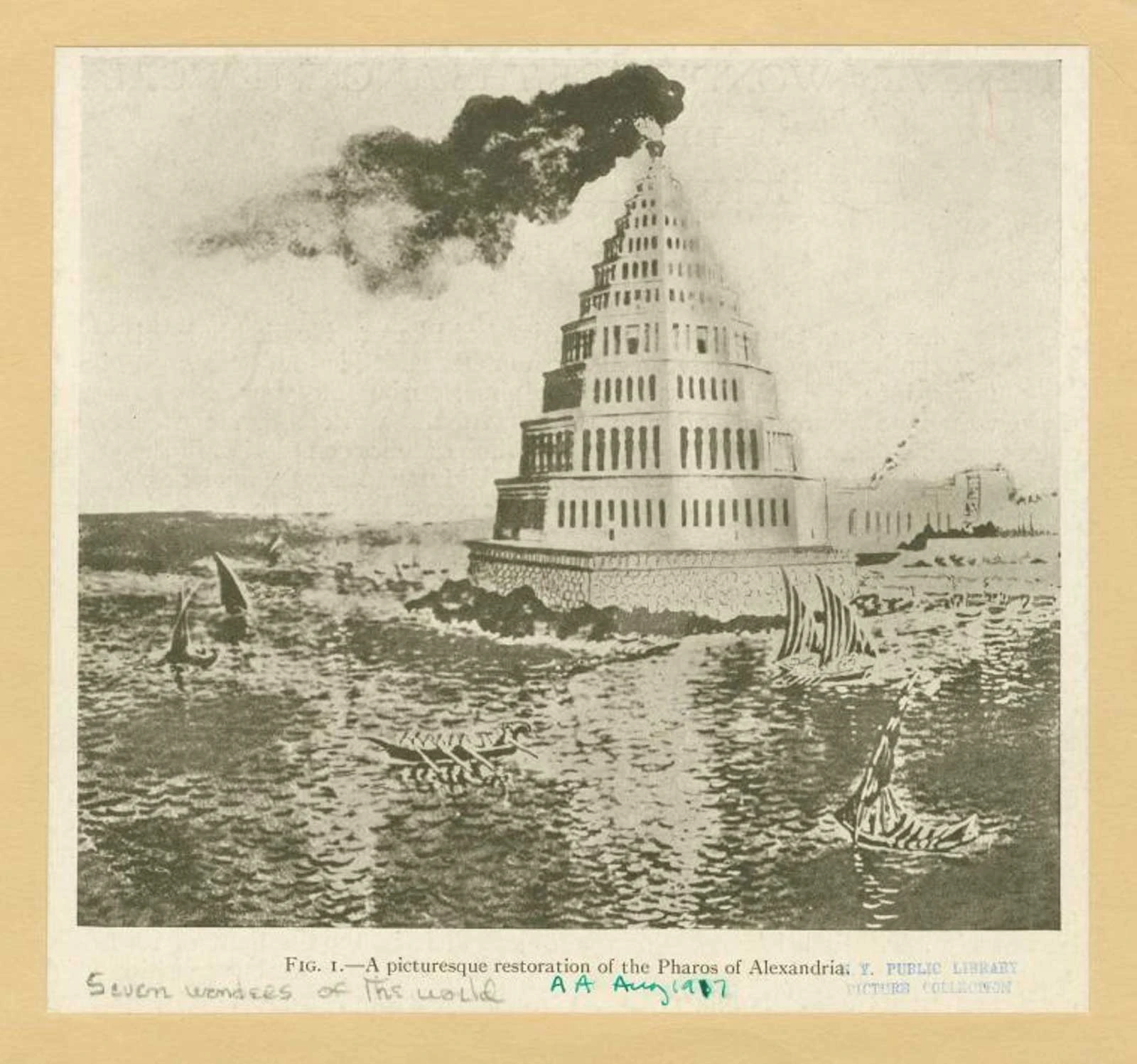
The Pharos was a towered lighthouse built in three stages: a square base, an octagonal middle section, and a cylindrical top, capped with a statue, likely of Zeus or Poseidon. Ancient sources give its height as somewhere between 100 and 130 metres, which would have made it the second tallest structure in the ancient world after the Great Pyramid at Giza.
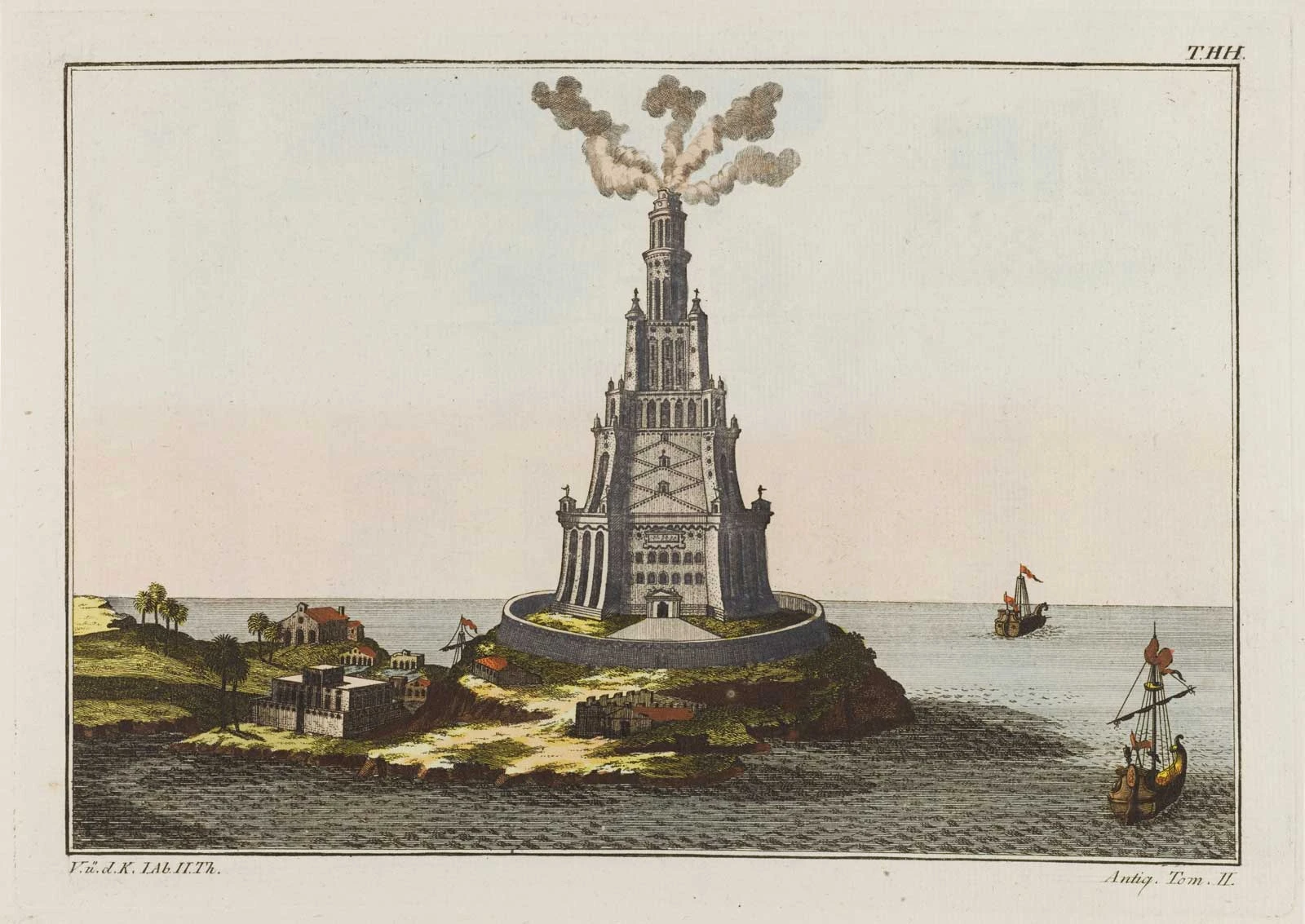
A fire or mirror system at the top was said to be visible for 50 kilometres out to sea. Ancient writers debated whether the light came from fire alone or was amplified by polished metal mirrors. The base of the lighthouse held a ramp wide enough for horses and carts to carry fuel to the top.
Where Was It
The Pharos stood on the eastern tip of the island of Pharos, which a causeway called the Heptastadion linked to Alexandria. That former island now forms a peninsula within the modern city. Today the Citadel of Qaitbay, a fifteenth- century Egyptian fortress, stands on the site and includes many stones taken from the ruined lighthouse.

Key Dates
- c.297 BCE. Ptolemy I Soter commissions the Pharos.
- c.280 BCE. The lighthouse is completed under Ptolemy II Philadelphus.
- 956. An earthquake causes the first significant structural damage.
- 1303. A major earthquake in the eastern Mediterranean causes severe damage.
- 1323. Arab traveller Ibn Battuta visits Alexandria and finds the lighthouse already too ruined to enter.
- 1375. A further earthquake reduces the Pharos to a ruin.
- 1477. The Mamluk Sultan Qaitbay builds his citadel on the site using lighthouse stones.
- 1994. Underwater archaeologists discover submerged remains of the lighthouse on the harbour floor.
Key Players
Sostratus of Cnidus is named by ancient sources as the architect of the Pharos. An inscription on the building reportedly read: “Sostratus of Cnidus, son of Dexiphanes, to the saviour gods, on behalf of those who sail the seas.” Ptolemy is said to have demanded his own name be placed there instead, but Sostratus reportedly cut his own name into the stone beneath a layer of plaster carrying the king’s name, knowing the plaster would one day fall away.
Ptolemy I Soter commissioned the lighthouse and began construction.
Ptolemy II Philadelphus oversaw its completion.
Ibn Battuta, the Moroccan traveller, visited Alexandria in 1323 and left one of the last eyewitness accounts of the structure, already partially collapsed.
The Story Behind It
The Pharos was so well known in antiquity that its name, taken from the island it stood on, became the word for lighthouse in French (phare), Italian (faro), Spanish (faro), and many other languages. Writers in the ancient and medieval world admired it, described it, and copied its form for well over a thousand years.
Arab geographers of the 10th and 11th centuries wrote detailed accounts of the Pharos and claimed that a mirror at the top could spot and even burn enemy ships far out at sea. Whether this was fact or legend, it shows how strongly the building gripped the medieval imagination.
The underwater survey of 1994 found large stone blocks on the harbour floor, some of them recognisable as parts of the lighthouse. Archaeologists and local authorities have discussed underwater excavation and a possible submerged archaeological park, but full plans have yet to be carried out.
The Citadel of Qaitbay that now stands on the site includes so much stone from the Pharos that archaeologists can pick out lighthouse masonry in its walls. The destroyer built from the destroyed.
“The Pharos gave its name to every lighthouse in the world. It is still standing, in a sense, in every harbour.”
What Came After It
Lorem ipsum dolor sit amet, consectetur adipiscing elit. Nulla nec malesuada risus. Fusce gravida metus lacus, vel viverra turpis mattis non. In hac habitasse platea dictumst. Quisque elementum, leo in tempor vestibulum, tellus tellus vehicula nulla, sit amet semper mi lacus at leo. Donec vitae nunc aliquam eros porta vulputate. Suspendisse sit amet mi sit amet nulla ornare ultrices ut at risus. Sed quis sagittis mi. Donec cursus ligula id lobortis volutpat. In risus est, aliquam et scelerisque ut, ultricies at mi. Integer dictum molestie condimentum. Donec condimentum tortor iaculis lobortis cursus. Donec sed viverra augue. In quis nisl tempus, venenatis risus nec, tincidunt nisi. Phasellus orci lectus, tincidunt nec ligula id, vehicula imperdiet lacus. Morbi iaculis aliquet nunc, fermentum imperdiet urna malesuada id. Vestibulum lobortis felis quis suscipit ullamcorper.